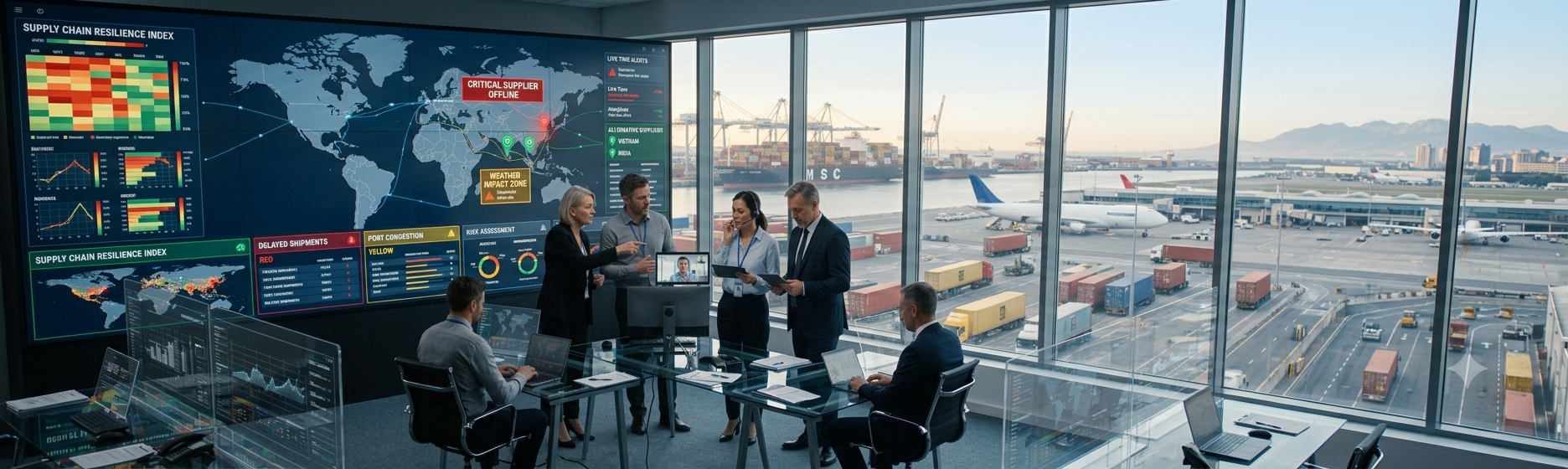
What Happens When Your Best Supplier Suddenly Disappears?
What Happens When Your Best Supplier Suddenly Disappears?
Beginning of a bright, shiny day on Monday morning.
You come to work with your procurement team expecting a normal day.
Everything changes in just a couple of minutes.
A key supplier has halted operations.
No warning.
No contigeny timeline.
No immediate alternative.
Within a few hours, scheduled productions are at risk. Customer deliveries are delayed. Leadership wants answers. The operations team is running for updates.
And suddenly, the complete supply chain turns into the biggest threat to the business which was perfectly stable just a day before today.
This situation is not hypothetical.
This is an actual scenario that businesses face.
In many industries, disruptions are happening more often and are increasingly complex and costly. Geopolitical instability, climate events, transportation bottlenecks, regulatory changes, cyber attacks, and instability of suppliers have turned supply chain management from being a back office function to being a top strategic priority of businesses.
Disruption is not a question of if anymore.
The question is, how prepared are you to respond to disruption?
For years, companies have built their supply chain on an efficient basis.
Inventory has been reduced.
Supplier bases have been consolidated.
Cost has been optimized.
Processes have been streamlined.
That model worked for a long time until it didn't.
The reason it didn't work well is that efficiency and resilience are not the same thing.
When uncertainty comes into play, supply chains that were designed only for speed will struggle to respond.
Today, companies are reassessing everything.
Rather than asking "How do we speed up our supply chain?"
The questions being asked now are:
"How do we strengthen our supply chain?"
"How do we create a smarter supply chain?"
"How do we create an adaptable supply chain?"
This change in thinking is driving what will be one of the biggest transformations ever within the industry.
Welcome to the era of the adaptive supply chain.
Why Visibility Acts As The New Competitive Edge
Ten years ago, many businesses lacked visibility beyond just their first-tier suppliers.
That model will no longer work.
The global supply chain has become a complex ecosystem that includes hundreds of countries, thousands of suppliers, millions of logistics providers, and billions of dollars’ worth of technology, with each component potentially creating risk.
An event that disrupts transportation in one geolocation could affect stock levels in another geo outside of that.
An event affecting a supplier who is 1000's of miles away can affect customer satisfaction at some future date.
Organizations can no longer operate without visibility.
That’s why the pace of investment in Supply Chain Analytics, AI-based forecasting, Digital Supply Chains, and Real Time Supply Chain Monitoring has accelerated exponentially.
Organizations want Visibility!
Visibility provides agility!
Agility provides resiliency!
However, visibility, by itself, does not solve our issues.
People, not Data, solve our problems.
In Supply Chains, the Most Important Asset Is Not Technology
We often see AI brought into the supply chain conversations these days, and every week, new AI-related platforms, dashboards, or automation tools are being launched in an effort to change the way we do things. There’s no doubt that AI is impacting the industry in many ways, such as giving us a tool to identify patterns that could easily be missed by humans. It has the ability to analyse thousands of variables in seconds, which enables it to predict disruptions prior to them developing into operational crises.
Yet, when an important decision is made, companies still turn to humans to do so.
Humans make decisions regarding supplier changes.
Humans negotiate contracts.
Humans weigh cost vs. service levels.
Humans assess risk.
Humans manage expectations from stakeholders.
Humans lead transformation.
Technology provides the information used to support a decision, whereas supply chain professionals make decisions based on that information.
In today’s world of uncertainty, the value of human judgment continues to increase, and as such, companies that rely solely on technology will increasingly have a difficult time competing in the future. Companies that value the importance of their employees how they can use technology to automate manual processes, and allow their employees to use their judgement to make decisions... will continue to operate successfully into the future based upon what they can accomplish with technology.
The Evolution of Supply Chain Professionals
Professional roles within supply chains are rapidly changing.
More than ever, people in supply chain leadership roles are required to understand more than just procurement, inventory, and logistics.
Supply chain leaders need to be able to navigate data, interpret analytics, understand digital transformation, evaluate risk, drive sustainability initiatives, manage supplier ecosystems, lead strategic sourcing decisions, and align operational performance with higher-level organizational objectives.
To put it simply:
Supply chain professionals are evolving into strategic business leaders.
The demand for supply chain professionals with expertise in Supply Chain Management, Procurement and Sourcing, Logistics Management, Supply Chain Analytics, Strategic Procurement, and Supply Chain Risk Management continues to grow as organizations invest in developing resiliency for the future.
When the next disruption hits (and it will), the measure of how well an organization handles it will depend almost entirely on the skills of those who manage the process.
The Future is Inevitable
Disruptions will happen; it is not a matter of "if". It is a matter of "when".
When disruptions happen, companies will not care whether they have the newest technology, rather they will want to know whether or not they have the right people capable of interpreting data and make good decisions about how the business works.
The future of supply chain management is about how to utilize both digital (technology) and physical (human) skills together.
Technology provides visibility into supply chain operations.
An analytics system helps to predict supply chain outcomes.
Automated processes improve supply chain efficiency.
The only thing that is constant is the people involved with those processes and how they adapt, recover, and continue to operate.
Companies looking for ways to be innovative and successful are recognizing this fact and are investing in building digital supply chains, as well as providing ongoing training for their employees. Skill sets in supply chain management, procurement, logistics, analytical capability, strategic sourcing, and risk management will continue to affect business outcomes, rather than just enhance careers.
For professionals working in this environment, there are many great opportunities as the supply chain industry continues to evolve at an ever-increasing speed. Staying relevant means having continuous learning opportunities and obtaining the globally recognized certifications that are required by today's supply chain industry.
At the Blue Ocean, we are experiencing this transformation directly. Professionals across different industries and countries are choosing to develop their skills in supply chain, purchasing, logistics and operations not just to get one more certification but to be the kind of people that companies depend on when they have to deal with complexity and disruption.
Every dashboard still requires someone to make decisions.
Every piece of information still needs to be acted upon.
And every resilient supply chain still requires professionals with the skills to manage uncertainty confidently.
The supply chain of the future will be driven by technology.
But they will be run by people who keep growing and improving in terms of their knowledge.