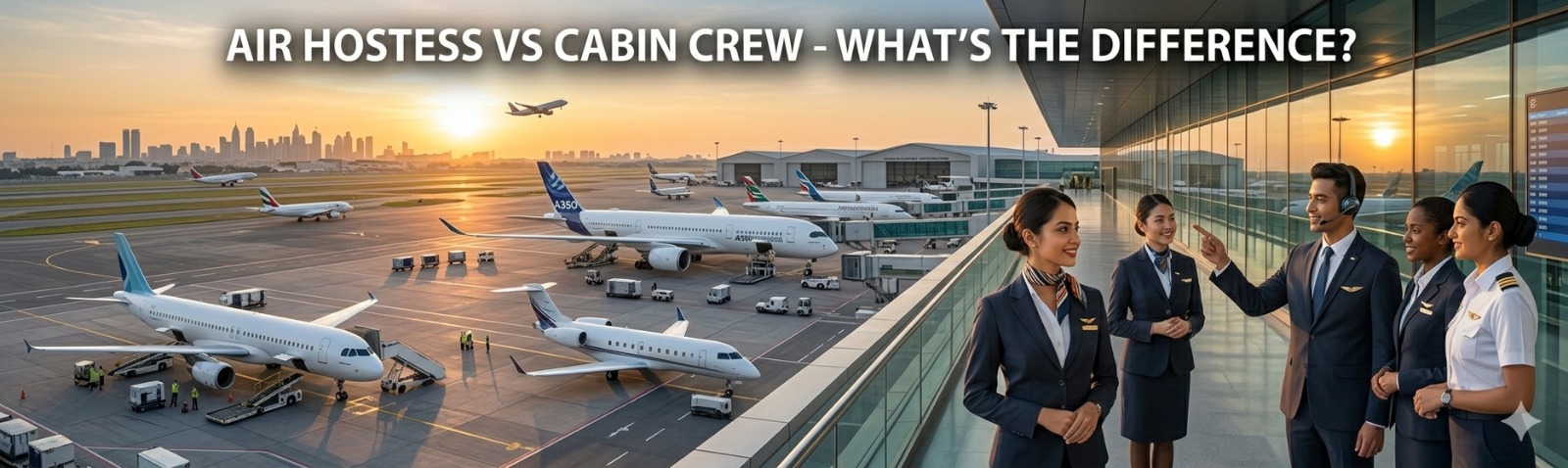
Air Hostess vs Cabin Crew - What's the Difference?
If you are exploring a career in aviation, you have almost certainly come across both terms: air hostess and cabin crew. Many people use them interchangeably, but are they actually the same thing? Understanding the air hostess vs cabin crew distinction - and what it means for your career - is an important starting point for anyone entering the aviation industry. This blog breaks it down clearly.
What Does 'Cabin Crew' Mean?
Cabin crew is the correct, internationally recognised term used by the aviation industry to refer to all flight service personnel who work inside the passenger cabin of an aircraft. This includes both male and female flight attendants at every level - from junior cabin crew members to senior pursers and cabin managers. Cabin crew meaning encompasses the full team responsible for passenger safety, comfort, and in-flight service. The term is gender-neutral and professional, and it is the standard terminology used by IATA, ICAO, DGCA, and all major airlines worldwide.
What Is an Air Hostess?
Air hostess is an older, colloquial term that became popular in the early days of commercial aviation when cabin crew roles were exclusively held by women. The term originated in the 1930s and gained widespread cultural recognition through the 1960s and 1970s. In India especially, 'air hostess' remains a commonly used term in everyday conversation and is understood by the general public to refer to female cabin crew members.
However, in a professional aviation context, 'air hostess' is considered outdated and somewhat limiting because it applies only to female crew members and does not capture the full scope of the role, which is first and foremost a safety function.
The Difference Between Air Hostess and Cabin Crew
The difference between air hostess and cabin crew is essentially one of terminology, scope, and professional context. Cabin crew is the umbrella term covering all genders and all levels of flight service personnel. Air hostess refers specifically to female cabin crew members and carries a cultural and historical connotation rather than a technical one. In terms of actual job responsibilities, training, and selection criteria, there is no functional difference between what is historically called an air hostess and the role of a female cabin crew member today.
Both are responsible for the same duties: conducting safety demonstrations, managing emergency procedures, delivering in-flight service, providing first aid, and ensuring passenger well-being.
Cabin Crew Job Role - What the Work Actually Involves
Regardless of what term is used, the cabin crew job role is a multifaceted one that combines safety expertise, customer service, and professional conduct. Specific responsibilities include pre-flight safety checks of the cabin and emergency equipment, conducting safety briefings and demonstrations, managing boarding and disembarkation processes, serving food and beverages and managing in-flight sales, handling passenger requests, complaints, and special needs, administering first aid and managing medical situations, operating emergency equipment and executing evacuation procedures when required, and completing post-flight reports and documentation.
The safety function is always primary. No matter how refined the in-flight service experience, the core reason cabin crew are required on every flight is aviation safety regulation - not hospitality.
Aviation Job Roles - Beyond the Cabin
It is also worth understanding that cabin crew is just one of many aviation job roles. The industry offers careers across a wide spectrum. Pilots and co-pilots operate the aircraft. Air traffic controllers manage aircraft movement on the ground and in the air. Ground staff handle passenger services and operations at the airport. Airport managers oversee all operational functions of an airport. Cargo and logistics specialists manage freight operations. Aviation engineers and technicians maintain the aircraft. Each of these roles has its own specific training, eligibility criteria, and career path.
Why the Terminology Matters
Using the correct terminology in aviation is more than a matter of semantics - it reflects your professional awareness of the industry. When you attend a cabin crew interview and refer to the role as cabin crew rather than air hostess, you signal to the recruiter that you understand the modern, gender-neutral, safety-first nature of the profession. It is a small detail that makes a real impression.
Frequently Asked Questions
Q: Is 'air hostess' still used by airlines?
A: Formally, no. All major airlines and aviation regulatory bodies use 'cabin crew' or 'flight attendant' as the standard terminology. 'Air hostess' persists in popular culture and everyday language in India but is not used in professional aviation contexts.
Q: Can men become cabin crew?
A: Absolutely. Cabin crew is a gender-neutral profession. Major airlines including IndiGo, Air India, Emirates, and Qatar Airways all recruit male cabin crew members. Male cabin crew are sometimes referred to as stewards or flight stewards in older terminology.
Q: What is the difference between cabin crew and flight attendant?
A: There is no meaningful difference. 'Flight attendant' is more commonly used in Western countries, particularly in the United States, while 'cabin crew' is the preferred term in international aviation and in India. Both refer to the same role.
Q: Does the term 'air hostess' affect my job application?
A: Not technically. But using 'cabin crew' in interviews and written applications demonstrates your professional understanding of the industry and reflects better on your preparation.
Whether you grew up calling them air hostesses or cabin crew, the person standing at the aircraft door to greet you with a warm smile is a trained safety professional with a multifaceted, demanding, and deeply rewarding job. If this career resonates with you, start by understanding the role in its full, modern context - and prepare accordingly.
How Blue Ocean Corporations Prepares You for the Role - By Its Correct Name
Understanding the difference between air hostess and cabin crew is the first sign that you are approaching this career seriously. Blue Ocean Corporations takes that seriousness and builds on it. Every program at Blue Ocean Corporations is grounded in the professional language, standards, and expectations of the modern aviation industry - which means from your very first session, you learn to think, speak, and carry yourself the way airlines actually expect. The curriculum is IATA-aligned, covering cabin crew roles across their full scope: safety-first, service-driven, and globally recognised. Whether your goal is to fly with a domestic carrier like IndiGo or Air India, or to pursue an international role with Emirates, Qatar Airways, or Singapore Airlines, Blue Ocean Corporations maps your training to that destination with precision. The grooming sessions, mock interviews, communication workshops, and placement drives are not add-ons - they are the core of what makes a Blue Ocean Corporations graduate walk into a selection room prepared, polished, and impossible to overlook.
If the cabin crew profession resonates with you - not just the idea of it, but the reality of what it demands and what it offers - then the next step is straightforward. Speak with the team at Blue Ocean Corporations. Explore the course that fits your profile. And begin building the career you have been researching. The aircraft door is not just a metaphor. At Blue Ocean Corporations, it is a destination we train you toward, every single day.
Ready to begin? Book your free career counselling session with Blue Ocean Corporations today.