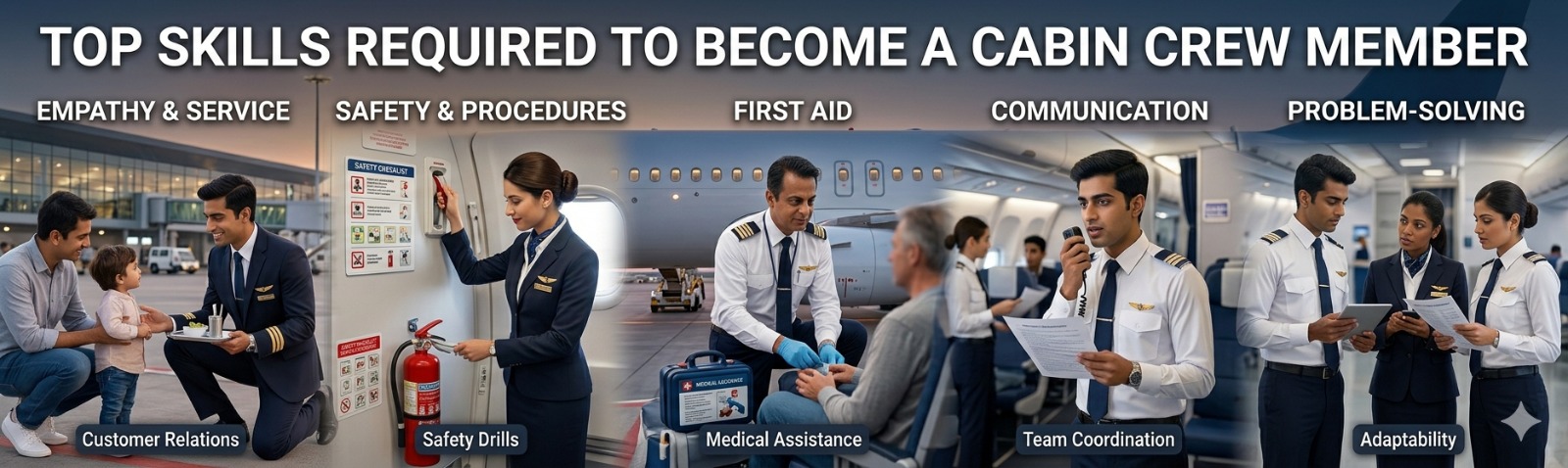
Top Skills Required to Become a Cabin Crew Member
Becoming a cabin crew member is about much more than looking the part. Airlines invest heavily in selecting candidates who possess the right combination of technical knowledge, interpersonal ability, and professional character. Understanding the cabin crew skills that airlines actively look for can help you focus your preparation and stand out from hundreds of other applicants. This guide covers the essential skills required for air hostess and cabin crew roles across domestic and international airlines.
1. Communication Skills for Cabin Crew
Communication sits at the heart of every cabin crew interaction. Whether you are delivering a safety announcement, calming a nervous passenger, coordinating with the cockpit crew during turbulence, or managing a difficult customer, your ability to communicate clearly and confidently defines your effectiveness in the role. Communication skills for cabin crew go beyond just speaking English fluently. They include the ability to adapt your tone to different situations, listen actively and empathetically, use non-verbal communication effectively -body language, eye contact, and posture all matter - and give clear, calm instructions during emergencies.
Airlines assess communication skills through group discussions, personal interviews, and sometimes role-play scenarios during the selection process. Candidates who can express themselves clearly, confidently, and warmly - without sounding rehearsed - consistently make the strongest impression.
2. Customer Service Excellence
Cabin crew are the face of the airline. Every passenger interaction - whether a simple water request or a complex complaint - shapes the airline's reputation. Skills required for air hostess roles include a genuine desire to serve, patience with difficult passengers, the ability to personalise service, and the resilience to maintain a warm, professional demeanour across long and demanding flights. Airlines are not looking for people who can fake friendliness. They want candidates who naturally enjoy engaging with people and find satisfaction in making others comfortable.
3. Safety and Emergency Competence
This is the most critical technical skill that cabin crew must develop and maintain. Every member of the cabin crew is a trained safety professional first and a hospitality professional second. Safety competencies include knowledge of emergency evacuation procedures, operation of emergency equipment such as fire extinguishers, life jackets, and emergency exits, administration of first aid and use of onboard medical equipment, handling of in-flight medical emergencies, and management of disruptive or unruly passengers.
Airlines conduct rigorous safety training and regular assessments to ensure that all crew members are capable of executing emergency procedures without hesitation.
4. Cultural Sensitivity and Adaptability
Aviation is one of the most culturally diverse work environments in the world. On any given flight, you may serve passengers from twenty different countries with vastly different cultural norms, dietary requirements, and communication styles. Qualities of cabin crew that stand out in this environment include cultural awareness and sensitivity, the ability to adapt service styles without stereotyping, multilingual ability or at least an open attitude toward language diversity, and the capacity to work harmoniously with colleagues from different backgrounds.
5. Teamwork and Coordination
A cabin crew operates as a tightly coordinated team. Individual brilliance is of limited value if a crew member cannot function effectively within the group. During flights, crew members rely on each other for safety briefings, service coordination, and managing unexpected situations. Strong teamwork involves proactively supporting colleagues, sharing workload equitably, communicating clearly within the crew, and maintaining professionalism even in high-stress situations.
6. Problem-Solving and Composure Under Pressure
Things do not always go according to plan at 35,000 feet. A passenger falls ill, a flight is significantly delayed, two passengers have a conflict, or an emergency unfolds unexpectedly. The ability to stay calm, think clearly, and take decisive action is among the most valued aviation industry skills that recruiters assess. This quality is difficult to teach - it is developed through training, experience, and a naturally composed temperament.
7. Grooming and Professional Presentation
Professional appearance is not about vanity - it is about representing the airline brand consistently and making passengers feel confident in the crew's professionalism. Every airline has detailed grooming standards covering hair, makeup, uniform maintenance, jewellery, and overall presentation. Maintaining these standards throughout a long-haul flight requires discipline and personal pride in one's appearance.
8. Physical Stamina and Mental Resilience
Cabin crew work irregular hours, cross multiple time zones, manage jet lag, and are on their feet for extended periods during flights. Physical fitness and mental resilience are not optional - they are job requirements. Candidates who demonstrate genuine fitness, energy, and a positive outlook toward the challenges of the role impress airlines during selection.
Frequently Asked Questions
Q: Which is the most important skill for cabin crew?
A: Safety competence is the most critical technical skill. However, communication and customer service skills define the quality of the passenger experience and are equally vital for career success.
Q: How can I develop communication skills for a cabin crew interview?
A: Practice speaking confidently in English every day. Join public speaking groups, take part in group discussions, and record yourself to identify areas for improvement. Professional communication training at a quality aviation institute can also help significantly.
Q: Do airlines test skills during the selection process?
A: Yes. Airlines use group discussions, role-play scenarios, psychometric assessments, and personal interviews to evaluate communication, problem-solving, teamwork, and customer service skills.
Q: Are there any courses to build aviation industry skills?
A: Yes. Cabin crew training programs at reputed aviation institutes cover all the essential skills comprehensively. IATA certification courses also develop specific aviation competencies that are recognised globally.
Building the right cabin crew skills is an ongoing process that begins before you apply and continues throughout your career. The candidates who succeed are those who develop these qualities genuinely, not just for the interview. Invest in yourself, train with the best, and approach every interaction - whether in the classroom, the mock aircraft, or the selection centre - as a demonstration of who you are as a future aviation professional.
Building These Skills Takes More Than Reading About Them
Every skill covered in this guide - communication, customer service, safety competence, grooming, resilience - has one thing in common: it cannot be developed by reading alone. It has to be practised, refined, corrected, and built through deliberate, structured training under the guidance of people who understand what airlines are genuinely looking for.
That is the gap between knowing what the skills are and actually possessing them when it matters most - in a group discussion, in a one-on-one panel interview, or in a mock emergency drill where there is no script and only your training to fall back on.
Airlines do not hire potential. They hire proof. And proof is what consistent, industry-aligned training produces.
How Blue Ocean Corporations Builds Each of These Skills
At Blue Ocean Corporations, every program is designed around a single understanding: the skills airlines test for are not soft qualities that candidates either have or do not have. They are competencies that can be taught, practised, and perfected - given the right environment, the right curriculum, and the right people in the room.
What sets Blue Ocean Corporations apart from generic aviation training is the IATA foundation built into every program. IATA certification validates that your skills have been developed to the same international benchmark that the world's leading airlines hold their own professionals to. When your training is IATA-aligned, you do not need to explain your preparation to a recruiter. The credential does that for you.
Blue Ocean Corporations offers IATA-certified programs across every major aviation career path - cabin crew, ground operations, airport management, cargo and freight, and travel and tourism. Whether you are building your first aviation qualification or adding a globally recognised credential to an existing profile, the curriculum, the faculty, and the placement support at Blue Ocean Corporations are structured around one goal: making you the candidate airlines want to hire.
You now know the eight skills that airlines look for. You understand what each one involves and why it matters. The only remaining question is what you do with that knowledge. Reading this guide is the beginning of awareness. Enrolling in the right training program is the beginning of your career.
Blue Ocean Corporations | IATA-Certified Aviation Training