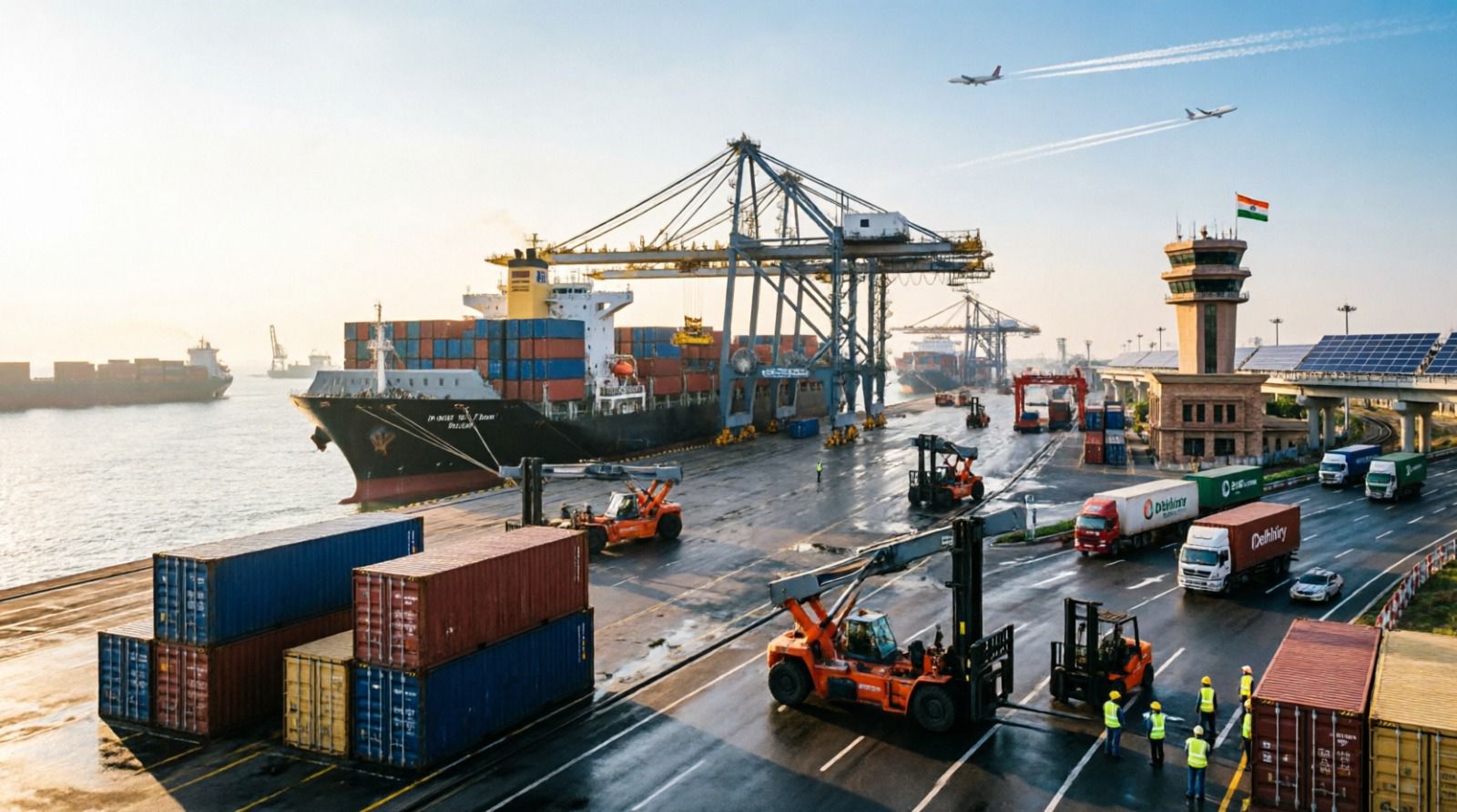
India’s Supply Chain Revolution: Connecting India to the World Through Supply Chain Excellence
Why India’s Supply Chain Transformation Could Define the Next Global Economic Era
The global supply chain order is being rewritten.
What once revolved around a few concentrated manufacturing economies is now rapidly diversifying - driven by geopolitical pressures, climate risks, widespread disruptions, and the growing demand for more resilient, agile, and cost-efficient sourcing strategies.
In this defining moment of global economic realignment, India is emerging as a force to be reckoned with.
No longer simply a large consumer market, India is carving its identity as a strategic manufacturing destination, a global sourcing powerhouse, and a supply chain ecosystem with the capability to connect businesses across the world.
True global leadership demands more - supply chains that are intelligent by design, seamlessly integrated, powered by technology, and built to compete without compromise.
India's supply chain transformation is a reality taking shape.
Over the past decade, landmark national programmes including PM Gati Shakti, the National Logistics Policy, Make in India, Digital India, and the PLI schemes have collectively accelerated India's industrial and logistics evolution at an unprecedented pace.
The results are increasingly hard to overlook. Industrial corridors are expanding. Ports are modernising. Warehousing infrastructure is scaling from fragmented to organised. Multimodal connectivity is steadily closing the gaps that once made India's vast geography a logistical challenge rather than an advantage.
India's logistics ecosystem is becoming faster, better connected, and more efficient with each passing year.
But progress demands honesty - and here is the distinction that matters most: Infrastructure creates movement. Supply chain excellence creates global competitiveness.
Bridging that gap is precisely where India's next chapter must be written.
The Real Challenge: Building End-to-End Supply Chain Capability
There is a gap at the heart of India's supply chain story - and it is not one that a new port or a faster freight corridor can close.
It lives inside organizations.
The real gap lies deeper - inside fragmented operational ecosystems where disconnected suppliers, siloed departments, manual planning systems, and limited visibility continue to create inefficiencies across the value chain.
The consequences are visible everywhere: inconsistent delivery timelines, forecasting inaccuracies, excess inventory, stockouts, rising operational costs, and slower decision-making.
As global supply chains become increasingly data-driven and resilient, India’s competitiveness will depend on how quickly organizations transition toward integrated business planning, predictive analytics, AI-enabled forecasting, and intelligent supply chain ecosystems.
India’s Strategic Dependency Challenge
India has emerged as a strong manufacturing force across sectors such as electronics, pharmaceuticals, renewable energy, and automotive production. Yet, critical dependencies on imported components and raw materials continue to create vulnerabilities.
From semiconductor components and battery materials to pharmaceutical APIs and rare earth minerals, global disruptions have highlighted the risks of excessive external dependency.
Strengthening domestic supplier ecosystems and building resilient sourcing networks will be critical for India’s long-term competitiveness in the global economy.
Sector-Wise Transformation Will Shape India’s Future
Across agriculture, pharmaceuticals, automotive, EVs, electronics, and textiles, India's supply chain story is one of enormous potential meeting equally significant structural challenge.
Each sector carries its own fault lines - fragmented operations, critical import dependencies, mounting sustainability expectations, and infrastructure gaps that require more than policy intent to bridge. But each also represents a category-defining opportunity for India to establish itself as a globally trusted, high-performance supply chain economy.
The industries that will shape India's next era of growth are those that move decisively - building supply chains that are resilient enough to absorb disruption, intelligent enough to anticipate change, and integrated deeply enough into global value chains to compete without compromise.
Why Supply Chain Capability Will Define National Competitiveness
The next era of economic leadership will be defined by supply chain capability.
Countries that can combine procurement excellence, manufacturing agility, logistics efficiency, digital transformation, supplier resilience, sustainability, and AI-driven decision-making will lead the future global economy.
Supply chains are no longer operational support functions hidden behind business performance.
They have become strategic national assets.
Connecting India to the World
At Blue Ocean Corporation, we believe India’s next economic revolution will be powered by supply chain transformation.
The vision is clear - helping organizations build resilient operations, strengthen supplier ecosystems, improve efficiency, accelerate export readiness, and develop future-ready talent capable of managing globally connected supply chains.
India already possesses the scale, ambition, and talent required to lead.
What the country now needs is accelerated capability development that can transform potential into global leadership.
The Future of Indian Supply Chains
The next generation of supply chains in India will be shaped by Artificial Intelligence, predictive analytics, digital control towers, IoT-enabled visibility systems, blockchain-driven transparency, and sustainable operating models.
Organizations will increasingly focus on ESG compliance, carbon reduction, circular economy integration, reverse logistics, and intelligent risk management as sustainability becomes central to global competitiveness.
Equally important will be talent development.
India has the opportunity to build one of the world’s largest ecosystems of highly skilled supply chain professionals capable of managing complex international operations across industries.
And that capability development will ultimately determine how successfully India connects itself to the world.
India stands at the threshold of becoming one of the most influential supply chain economies of the future
The opportunity is significant. The foundation is being laid. The global appetite for what India can offer has never been greater.
But infrastructure creates readiness - not leadership.
Leadership is earned through strategic capability through supply chains that are intelligent, resilient, and globally integrated. Through talent that understands not just how supply chain’s function, but how to make them excel. Through organizations and institutions willing to invest in excellence before the competition forces their hand.
The nations that command supply chains will command the future of global commerce.
India has the scale, the talent, and the ambition to be among them.
Great nations are not made in moments of opportunity. They are made in moments of decision.