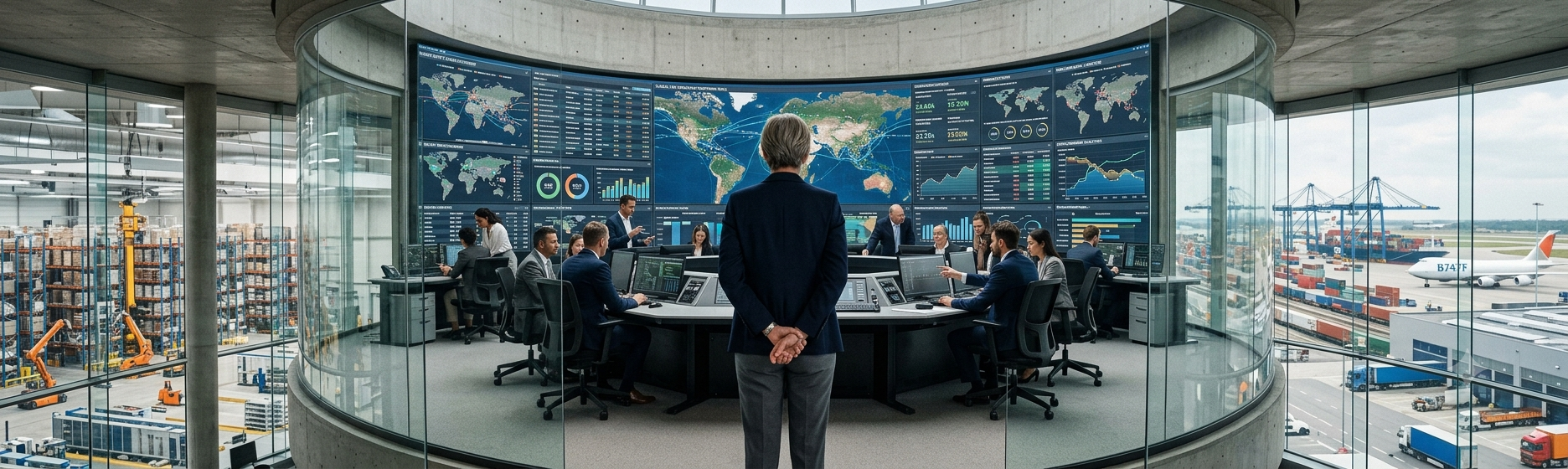
Beyond Logistics: How Supply Chain Management Is Transforming Global Business
Beyond Moving Boxes: The
Strategic Evolution of Global Trade
In the modern marketplace, the
terms "logistics" and "supply chain management" are often
tossed around as synonyms, yet for a scaling business, the distinction is the
difference between surviving and thriving. Logistics is the tactical
"boots on the ground"-the precise movement and storage of goods from
point A to point B. In contrast, supply chain management is the grand strategy,
an overarching architecture that harmonizes everything from raw material
procurement to the final "unboxing" experience for the customer. As
global markets grow more volatile, successful leaders are shifting their focus
from simple transportation to holistic ecosystem management.
Navigating the Chaos of
Modern Fulfilment
The current landscape is
fraught with challenges that can sink an unprepared enterprise. We are living
in an era of volatile lead times where a single maritime bottleneck can derail
a quarter’s projections. Many businesses struggle with "Data Silos,"
where the warehouse team is operating on a completely different set of numbers
than the finance department. This disconnects leads to the most expensive
mistake in the industry: manual error. Over-reliance on static spreadsheets
inevitably results in either the nightmare of stockouts or the capital-draining
reality of overstocking.
The 5 Pillars of a
Future-Proof Supply Chain
1. The Glass Warehouse:
Achieving Total Visibility
You cannot manage what you
cannot see. In a world of fragmented supply chains, real-time inventory
visibility is the primary defence against operational decay. By implementing
cloud-based systems, consultants can empower businesses to track stock levels
across multiple geographical locations instantly. This transparency actively
reduces "Dead Stock" capital-money that would otherwise sit gathering
dust on a shelf. Leveraging the Zoho Books inventory module allows for a
seamless sync where sales orders automatically update stock levels, providing a
single source of truth for the entire team.
2. Set It and Forget It:
The Power of Automated Procurement
Even the most capable teams are stretched thin when routine reordering competes with higher-value work. Modern optimization relies on automated procurement workflows that take the repetitive guesswork out of purchasing, so your team can focus on strategy, supplier relationships, and exceptions that truly need a human eye. By setting "low-stock" triggers, the system acts as a tireless sentinel, generating purchase orders the exact moment a threshold is crossed. This proactive stance keeps production running smoothly and lets people spend their time where it matters most, instead of tracking line items on a spreadsheet.
3. Closing the Gap: Syncing
Logistics with the Ledger
True operational excellence
occurs when your logistics costs-shipping, duties and warehousing are mapped
directly to your Cost of Goods Sold (COGS). When financial tracking is
integrated, a business moves from "estimated" costs to "actual"
real-time profitability data. Comparing manual management to an automated
system like Zoho Books reveals a stark contrast: manual entry is high-risk and labour-intensive,
while a synced system offers high scalability and surgical precision in cost
attribution.
4. Predicting the Future:
Avoiding the Bullwhip Effect
Demand forecasting is the art
of using yesterday’s data to shield yourself from tomorrow’s uncertainty. By analysing
historical trends, businesses can predict future needs with startling accuracy,
preventing the "Bullwhip Effect." This phenomenon occurs when minor
fluctuations at the retail level cause massive, expensive swings in wholesale
production. A stabilized supply chain is a predictable one, and a predictable
one is inherently more profitable.
5. From Vendors to
Partners: Cultivating Relationship Capital
The final pillar rests on how
you treat your suppliers. Vendor Relationship Management is the transition from
transactional interactions to strategic partnerships. Utilizing integrated
portals for clear, real-time communication reduces friction and improves your
negotiation leverage. When your vendors have visibility into your needs and you
have visibility into their capacity, the entire chain grows stronger.
Navigating the Logistics Landscape
What is the core difference
between logistics and supply chain management?
Think of logistics as a
critical piece of the puzzle and SCM as the entire picture. Logistics focuses
on the efficient movement and storage of goods, while supply chain management
encompasses the entire lifecycle, from sourcing raw materials to final delivery
and even returns management.
How does automation
fundamentally change a logistics operation?
Automation acts as a force
multiplier. It slashes manual data entry time, eliminates human error in the
picking and packing stages, and provides customers with the real-time tracking
they have come to expect. It also allows for sophisticated route planning that
significantly cuts fuel and labor costs.
What are the "7
Rs" that define logistics success?
The 7 Rs are a checklist for
excellence: Getting the Right product, to the Right customer, in
the Right quantity, at the Right condition, at the Right
place, at the Right time, and at the Right price. Failing at any
one of these can break customer trust.
What is the fastest way to
reduce supply chain overhead?
The most immediate impact
comes from optimizing inventory levels to decrease holding costs. By using
data-backed volume proof to negotiate better rates with carriers and automating
repetitive administrative tasks, businesses can significantly lower their
operational burn rate.
Beyond moving boxes lies the
real competitive advantage: intelligent orchestration. Supply chains today are
living systems-dynamic, interconnected, and deeply strategic. Organizations
that embed automation, financial integration, predictive analytics, and strong
vendor alliances into their DNA unlock sustainable profitability. But
transformation begins with expertise.
Ready to lead the next era of supply chain excellence? Explore Blue Ocean’s globally recognized certifications and take the first step toward becoming a future-ready supply chain leader. Programs such as CISCP (Certified International Supply ChainProfessional), CISCM (Certified International Supply Chain Manager), CIPP(Certified International Procurement Professional), and CIPM (CertifiedInternational Procurement Manager) offered by Blue Ocean Corporation.
Because in the end, supply
chains don’t compete-capabilities do.